
Gas prices jumped a dollar a gallon in a single month.1 The Iran conflict has taken 20% of global seaborne oil offline.2 Consumers were already stretched. Now they’re making harder choices, faster.
If you’re a CPG leader, this moment feels familiar. And so does the response.
Cut prices. Increase promotion. Protect volume.
PepsiCo dropped snack prices by as much as 15%.3
General Mills cut prices across two-thirds of its North American portfolio.4
Kraft Heinz committed $600 million to “fix the business.”5
It’s rational. It’s decisive. It’s exactly what your competitors are doing.
And, according to the data, it’s also the wrong instinct.
Private label just hit a record $282.8 billion in U.S. sales — 21.3% share, up for the fifth straight year.6 And more than half of consumers say they’ll stay with store brands, even when prices normalize.7
At the same time, premium CPG is growing.
The same household trading down in one aisle is trading up in another. At Flowers Foods, premium Dave’s Killer Bread and private label both gained share while mid-tier Nature’s Own lost ground.8
The market isn’t going cheap. It’s splitting.
When pressure hits, it triggers what we call the Reflex Loop:
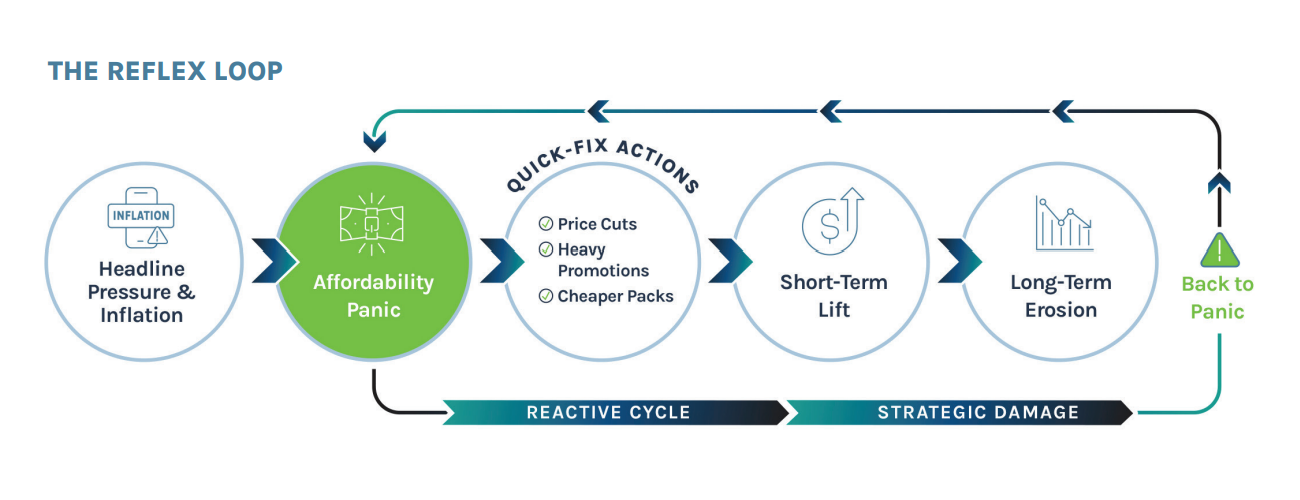
A headline lands.
It creates urgency.
Urgency triggers price cuts, promotions, and pack-size changes.
There’s a short-term lift. Then comes long-term erosion of margin, brand, and pricing power. Then the next shock hits and the cycle repeats.
The issue isn’t that brands are reacting. It’s that they’re reacting without diagnosing.
Because brands losing share don’t have a price problem. They have a differentiation problem.
The evidence is already in the market.
General Mills cut prices broadly and still saw volumes fall 3% last quarter.9
Conagra Brands said it directly: “You can’t shrink your way to prosperity as a CPG.”
Meanwhile, Unilever grew North American volumes 3.8% by investing more in brands, not less.
Coca-Cola addressed affordability with smaller formats without discounting the core.10
Different playbooks. Different outcome.
So, before you respond to the next macro headline, ask a harder question:
Do you have a price problem? Or do you have a differentiation problem?
Because in a world of $110 oil and rising input costs, every price cut you make today shows up as a margin problem tomorrow.
The brands that win this cycle will be disciplined enough to diagnose first. We dig deeper into six questions to help you diagnose in our latest whitepaper here: LINK
Until next time,
Michael
Sources:
[1] AAA Fuel Gauge Report, March 2026 — gasprices.aaa.com
[2] IEA / Fortune, March 2026 — fortune.com
[3] Modern Retail, February 2026 — modernretail.co
[4] Food Navigator, December 2025 — foodnavigator-usa.com
[5] Fox Business, February 2026 — foxbusiness.com
[6] PLMA / Circana, January 2026 — plma.com
[7] NielsenIQ Global Private Label Report, 2025 — nielseniq.com
[8] BBF Digital, 2025 — bbf.digital
[9] Unilever, Q4 2025 — unilever.com
[10] CNBC / Mobility Plaza, 2025 — mobilityplaza.org